

A bilingual brain belongs to an individual who regularly uses two or more languages. This exposure can occur simultaneously from birth (simultaneous bilingualism) or later in life (sequential bilingualism) in various settings, such as at home, in bilingual schools, or through immersive programs.
Prior to the 1960s, a widespread myth prevailed: the belief in a cognitive deficit. People believed that bilingualism caused “mental confusion”, assuming that children exposed to two languages would struggle academically. This misconception persisted until 1962, when psychologists Elizabeth Peal and Wallace Lambert published their breakthrough study The Relation of Bilingualism to Intelligence. Their research demonstrated that bilingual children achieved better cognitive results compared to monolingual peers of similar backgrounds. This marked the beginning of a wide range of experiments and neuroimaging studies that have consistently confirmed the cognitive benefits of bilingualism.
Studies emphasize that children gain the greatest benefits from bilingualism (BRITTON, 2025), largely due to neuroplasticity (GUALTIERI, 2022) — the brain’s ability to form new neural connections throughout life. Its peak occurs between ages 0 and 3, when synapse formation is extremely rapid. Unfortunately, this ability decreases across the lifespan. Some studies suggest that around 25 years old is the maximum age to learn something with relative ease. However, this does not mean that learning can not happen after it—the benefits remain accessible at any age. Below there is table 1 representing age versus neuroplasticity level.
Table 1 – Neuroplasticity Across the Lifespan
| Age Range | Level of Neuroplasticity | Key Features |
|---|---|---|
| Infancy (0–3 years) | Extremely high | Rapid synapse formation; language and sensory development. |
| Childhood (4–12 years) | Very high | Strong ability to learn languages, motor skills, and adapt to new environments. |
| Adolescence/Adulthood (13–25 years) | Peak levels | Brain circuits for executive function and emotional regulation are highly adaptable. |
| Adulthood (25–60 years) | Moderate | Neuroplasticity slows but persists; learning new skills, therapy, and training can still reshape the brain. |
| Older age (60+ years) | Reduced but present | Cognitive reserve helps maintain function; activities like bilingualism, exercise, and mental training can delay decline. |
What kind of benefits are we talking about?
What have scientists discovered over the years? Scientists have made a surprising discovery: a bilingual brain actually changes physically. Right below there is an infographic to illustrate the advantages to being exposed to an immersive world since very young.
Figure 1: Benefits of a Bilingual Brain Infographic
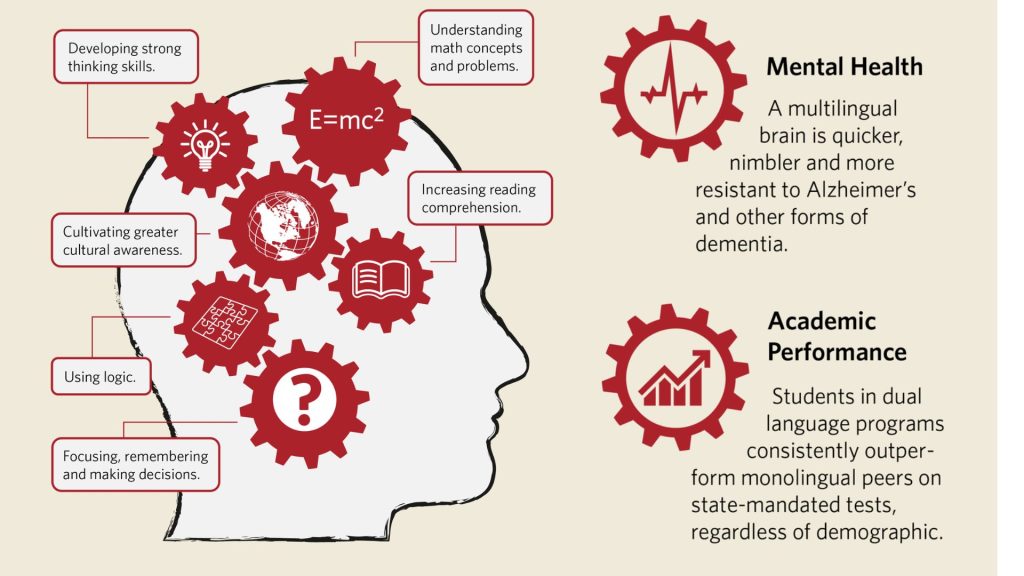
Source: Elearning Infographics (2019).
Switching back and forth between languages trains the brain beyond classroom activities. The benefits below include cognitive skills and 21st-century competencies enhanced by the “brain workout”:
- Attention
- Creativity
- Logical Thinking
- Memory
- Problem solving
Did you know that while exercising language skills, a bilingual brain also protects overall health? Research shows that bilingualism can help reduce the risk of several conditions, including (ELEARNING INFOGRAPHICS, 2019; COULTER, 2024; MARIAN & WILLIAMS, 2023; MACKAY, 2017; ALLIDA at all, 2025):
- Alzheimer
- Dementia
- Depression
- Heart disease
- Stroke
Don’t you feel more intelligent and healthier? If not, you should—because that is exactly what decades of research have demonstrated.
Now it’s time to share: Do you have a personal bilingual experience, or are you raising a bilingual child? We would love to hear your story. Tell us about your journey!
References:
ALLIDA, Sara; et al. Cardiovascular disease and stroke prevention in culturally and linguistically diverse communities: a systematic review. European Journal of Preventive Cardiology, Oxford University Press, 2025. Advance online publication. DOI: https://doi.org/10.1093/eurjpc/zwaf145. Disponível em: https://academic.oup.com/eurjpc/advance-article/doi/10.1093/eurjpc/zwaf145/8086508. Acesso em: 2 fev. 2026.
BRITTON, Sigifredo Castell. Why bilingual kids have a learning advantage. Psychology Today, New York, 30 jan. 2025. Disponível em: <https://www.psychologytoday.com/us/blog/psyched/202510/why-bilingual-kids-have-a-learning-advantage>. Acesso em: 2 fev. 2026.
COULTER, R.; et al. Bilinguals show evidence of brain maintenance in Alzheimer’s disease. Bilingualism: Language and Cognition, Cambridge University Press, 2024. DOI: https://doi.org/10.1017/S1366728924000012. Disponível em: https://www.cambridge.org/core/journals/bilingualism-language-and-cognition/article/bilinguals-show-evidence-of-brain-maintenance-in-alzheimers-disease/361106CAD89B93CCAC8463CC90C3CCE0. Acesso em: 2 fev. 2026.
DEELEN, Grace Van. The bilingual brain. MIT Technology Review, Cambridge, 25 out. 2022. Disponível em: <https://www.technologyreview.com/2022/10/25/1060386/the-bilingual-brain/>. Acesso em: 26 jan. 2026.
ELEARNING INFOGRAPHICS. Benefits of a bilingual brain [infográfico]. 2019. Disponível em: <https://elearninginfographics.com/benefits-of-a-bilingual-brain-infographic/>. Acesso em: 26 jan. 2026.
GROSJEAN, François. Life as a Bilingual: Knowing and Using Two or More Languages. Cambridge: Cambridge University Press, 2021. p. 281-300.
GUALTIERI, Samantha; FINN, Amy S. The sweet spot: When children’s developing abilities, brains, and knowledge make them better learners than adults. Perspectives on Psychological Science, v. 17, n. 5, p. 1322-1338, 2022.
MACKAY, Daniel F.; et al. The role of spoken language in cardiovascular health inequalities. BJGP Open, London, v. 1, n. 4, p. bjgpopen17X101241, 2017. DOI: https://doi.org/10.3399/bjgpopen17X101241. Disponível em: https://bjgpopen.org/content/1/4/bjgpopen17X101241. Acesso em: 2 fev. 2026.
MARIAN, Viorica; WILLIAMS, Aya I. Bilingual therapy and mental health. Psychology Today, New York, 10 out. 2023. Disponível em: <https://www.psychologytoday.com/us/blog/language-and-mind/202310/bilingual-therapy-and-mental-health>. Acesso em: 2 fev. 2026.
PEAL, Elizabeth; LAMBERT, Wallace E. The relation of bilingualism to intelligence. Psychological Monographs: general and applied, v. 76, n. 27, p. 1, 1962.
By Cícera Santos

Cícera Santos has degrees in Language Arts and Pedagagogy. She has postgraduate degrees in Bilingual Education and Neuropsychopedagogy. She holds Cambridge certifications: TKT, TKT YL, TKT CLIL and CELTA. She has been working in the field of Education for 15 years.